
A listing of current books on DITA (and DITA-related) that are available, with the most recent titles listed first. The descriptions are those provided by the publishers.
(By the way, if you end up wanting to buy any of the titles here and want to help defer my costs for running this website, please buy via the Amazon links below. Thank you!)
If I am missing anything, please email me and let me know!
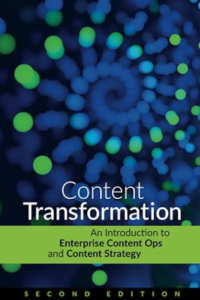
Content Transformation: An Introduction to Enterprise Content Ops and Content Strategy (2nd Edition), by Scriptorium Publishing
“Our digital world demands smart content—information that is structured, tagged, and labeled for machine processing. Discover perspectives from the Scriptorium team on structured content, content strategy, content operations, AI, and more with this collection of white papers and posts compiled from scriptorium.com.”
Includes chapters devoted to working strategically with DITA, such as “The DITA business case: Maximizing content value”, and “Managing DITA projects: Five keys to success”.
A PDF version of this book can be downloaded for free by subscribing to Scriptorium.
DITA XML (memorialised), Kindle Edition, by Joe Dorward

“So, why ‘memorialised’? It’s because I wrote this book to memorialise what I’d learned about DITA XML while working at Cisco in 2020, with the intention that I’d be able to ‘hit the ground running’ when I next need to work with it.
I am no kind of DITA XML expert. All I know, is what I’ve been told and what I’ve learned by trial and error. This is what works for me, and what works for me, may well work for you.”
Word To DITA XML, Kindle Edition, by Joe Dorward
“So, why ‘memorialised’? It’s because I wrote this book to memorialise the VBA (Visual Basic for Applications) sub-procedures that I created to convert Word documents to DITA XML while working at Cisco in 2020, with the intention that I’d have a handy library when I next needed them. This book is not intended to be more than a guide for those already ‘skilled in the art’ of VBA sub-procedures. For that reason, the examples are intentionally high-level (show) without detailed explanation (not tell). Although I wrote this book for myself, it may also usefully remind you about that which you already know and understand.”
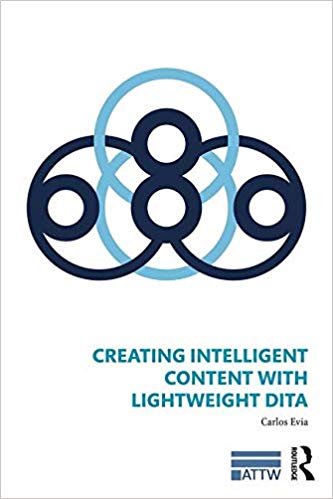
Creating Intelligent Content with Lightweight DITA, by Carlos Evia (December 2018)
“Creating Intelligent Content with Lightweight DITA documents the evolution of the Darwin Information Typing Architecture (DITA) – a widely used open standard for structuring technical content. DITA has grown in popularity and features since its origins as an internal grammar for structuring technical documentation at IBM. This book introduces Lightweight DITA (LwDITA, which should be read as “Lightweight DITA”) as a proposed version of the DITA standard that reduces its dependence on complex Extensible Markup Language (XML) structures and simplifies its authoring experience. This volume aims to reconcile discrepancies and similarities in methods for authoring content in industry and academia and does so by reporting on DITA’s evolution through the lens of computational thinking, which has been connected in scholarship and media to initiatives for learning to code and programming.”
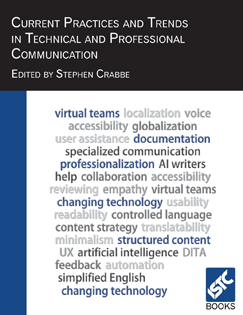
Current Practices and Trends in Technical and Professional Communication, edited by Stephen Crabbe
(July 2017)
“Technical and professional communicators are experts in making complex systems and worlds understandable to those who need to access them. However, both the concepts we are communicating about and the tools we are communicating with are changing at a rapid pace. To communicate effectively, we need our own knowledge and understanding to remain current, identifying best practice and learning from the experience of others.
The topics in this book cover important issues affecting the work we do (including globalization, localization and accessibility), and the tools and processes we can use to resolve some of those we encounter. Changes in technology are described, and ways of harnessing that technology are identified, including both current and future possibilities.”
Includes two chapters on DITA:
- The development of DITA XML and the need for effective content reuse, by Keith Schengili-Roberts
- Training technical communication students in structured content using DITA, by Nolwenn Kerzreho
For more information, see the chapter excerpt and full table of contents.
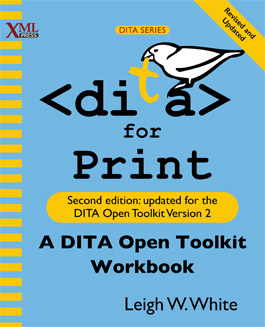
DITA for Print: A DITA Open Toolkit Workbook, Second Edition, by Leigh W. White
(February 2017)
“As DITA has become more and more popular, demand has increased for tools that can provide high quality PDFs from DITA content. The DITA Open Toolkit provides a basic PDF capability, but nearly any real-world application will require customization.
Leigh White’s book, DITA for Print, has become the go-to reference for building a print customization plugin for the DITA Open Toolkit. This second edition covers Open Toolkit, version 2, including customizing the DITA 1.3 troubleshooting topic type, localization strings, bookmarks, and the new back-cover functionality.
DITA for Print is for anyone who wants to learn how to create PDFs using the DITA Open Toolkit without learning everything there is to know about XSL-FO, XSLT, or XPath, or even about the DITA Open Toolkit itself. DITA for Print is written for nonprogrammers, by a non-programmer, and although it is written for people who have a good understanding of the DITA standard, you don’t need a technical background to get custom PDFs up and running quickly.”
DITA: The Topic-Based XML Standard: A Quick Start, by Sissi Closs
(May 1, 2016)
“This book presents a concise, real-world description of DITA principles. Explanations are provided on the basis of simple, applicable examples. The book will be an excellent introduction for DITA novices and is ideal as a first orientation for optimizing your information environment.”
A Practical Guide to XLIFF 2.0 Paperback, by Bryan Schnabel, JoAnn T. Hackos, Rodolfo M. Raya (October 9 2015)
Link: Amazon
“A Practical Guide to XLIFF 2.0 introduces the OASIS XLIFF standard. Companies use XLIFF to standardize the exchange of source and localized content with localization and translation vendors.
You will learn how to get the most from the XLIFF standard, use best practices in your translation workflow, extend XLIFF, and use the XLIFF modules.
This book is for localization coordinators, technical writers, content management system vendors, localization service providers, and consultants who want to incorporate XLIFF into their customers’ publishing workflow.
Getting Started: introduces XLIFF, the translation process, and the major parts of XLIFF, including the core and modules.
Applied XLIFF: describes how XLIFF supports translation of XML (including DITA), websites, office documents, graphics, and software user interfaces.”
DITA for Print, by Leigh W. White (October 2013)
Links: Amazon.com
“As DITA has become more and more popular, demand has increased for tools that can produce high quality PDFs from DITA content. The DITA Open Toolkit provides a basic PDF capability, but nearly any real-world application will require customization. Leigh White’s new book, DITA for Print, scheduled for publication in October 2013, takes you through the process of building a print customization plugin for the DITA Open Toolkit that will give you control over your PDF output.
DITA for Print is for anybody who wants to learn how to create PDFs using the DITA Open Toolkit without learning everything there is to know about XSL-FO, XSLT, or XPath, or even about the DITA Open Toolkit itself. DITA for Print is written for non-programmers, by a non-programmer, and although it is written for people who have a good understanding of the DITA standard, you don’t need a technical background to get custom PDFs up and running quickly.”
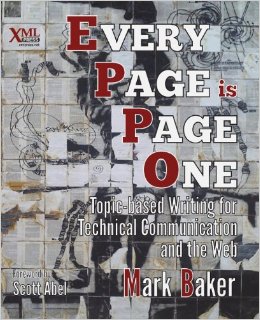
Every Page Is Page One: Topic-Based Writing for Technical Communication and the Web, by Mark Baker (October 2013)
Links: Amazon.com

[While not a book about DITA per se, this book does look at DITA’s topic-based approach to writing and it appears as though it would be useful to those working with DITA].
“The Web changes how people use content; not just content on the Web, but all content. If your content is not easy to find and immediately helpful, readers will move on almost at once. We are all children of the Web, and we come to any information system, including product documentation, looking for the search box and expecting every search to work like Google. There is no first, last, previous, next, up, or back anymore. Every Page is Page One.
For technical communicators, this Every Page is Page One environment presents a unique challenge: How do you cover a large and complex product using only topics, and how do you enable your readers to find and navigate topic-based content effectively?
In this ground-breaking book, Mark Baker looks beyond the usual advice on writing for the Web, and beyond the idea of topic-based writing merely as an aid to efficiency and reuse, to explore how readers really use information in the age of the Web and to lay out an approach to planning, creating, managing, and organizing topic-based documentation that really works for the reader.”
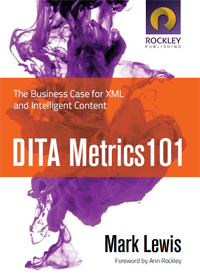
DITA Metrics 101, by Mark Lewis (February 2013)
Links: Lulu.com (Publisher), Supporting website, Sample chapter from the book
“You can’t manage what you can’t measure. Whether you’re a content strategist or documentation specialist looking to justify the purchase of tools and services to enable the implementation of new processes, or an executive wanting to understand how implementing a content strategy can help a corporation achieve its corporate goals — this book is for you!
You’ve probably read articles or papers that proclaim the benefits of moving your content to DITA: accuracy, consistency, increased productivity, reduced authoring times, etc.
But you need to know by how much. How much savings? How much increased productivity? How much for YOUR project, YOUR content? Because yours is different from everyone else’s. What is your project going to cost with DITA and content reuse? And if you’re currently using or recently implemented DITA, how do you track the success of the project?
Follow the steps in this book to create custom models that estimate the cost of your content in DITA and the cost of your new processes that support the DITA content lifecycle. Then, use these models to predict the cost of your documentation project. Compare your current costs to your costs using DITA. That difference is your savings and you’ll likely find that this number alone can be used justify to justify switching to DITA and structured content.”
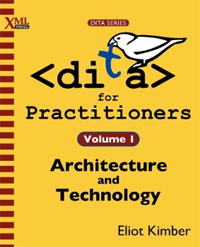
DITA for Practitioners Volume 1: Architecture and Technology, by Eliot Kimber (April 23, 2012)
Links: Amazon.com

“DITA expert Eliot Kimber takes you inside the DITA XML standard, explaining the architecture and technology that make DITA unique.
Volume 1 of his two-volume exploration of DITA starts with a hands-on explanation of end-to-end DITA processing that will get you up and running fast. Then, he explores the DITA architecture, explaining maps and topics, structural patterns, metadata, linking and addressing, keys and key references, relationship tables, conditional processing, reuse, and more.
Kimber’s unique perspective unwraps the puzzle that is DITA, explaining the rationale for its design and structure, and giving you an unvarnished, detailed look inside this important technology.”
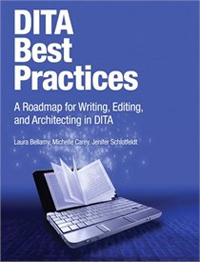
DITA Best Practices: A Roadmap for Writing, Editing, and Architecting in DITA by Laura Bellamy, Michelle Carey, Jenifer Schlotfeldt (Oct 17, 2011)
Links: Amazon.com

“The Start-to-Finish, Best-Practice Guide to Implementing and Using DITA
Darwin Information Typing Architecture (DITA) is today’s most powerful toolbox for constructing information. By implementing DITA, organizations can gain more value from their technical documentation than ever before. Now, three DITA pioneers offer the first complete roadmap for successful DITA adoption, implementation, and usage.
Drawing on years of experience helping large organizations adopt DITA, the authors answer crucial questions the “official” DITA documents ignore, including: Where do you start? What should you know up front? What are the pitfalls in implementing DITA? How can you avoid those pitfalls?”
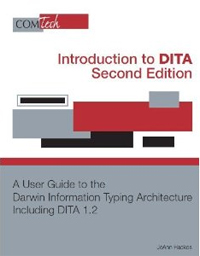
Introduction to DITA: A User Guide to the Darwin Information Typing Architecture, Second Edition-A User Guide to the Darwin Information Typing Architecture Including DITA 1.2, by JoAnn T. Hackos (2011)
Link: Amazon.com

“This new 2011 edition of the bestselling Introduction to DITA includes DITA 1.2 mechanisms, including keyref, conkeyref, constraint mechanism, and more information to bring DITA users up to date. The tutorial lessons guide you step-by-step through the learning process from developing information topics and maps through content reuse mechanisms and modifying the DITA environment to better meet your needs.
We’ve added a lot to the Second Edition—about 100 pages worth of new content (and for the same price as the first edition). It’s been a big job, started long before the official release of the DITA 1.2 specification in late 2010. As a founder and member of the DITA Technical Committee, I have long known about the new additions to the DITA framework that would especially interest communication professionals.
The Second Edition adds discussions and exercises relating to features introduced in the DITA 1.1 and 1.2 specifications:
- Bookmaps
- Glossary topics
- Content reuse mechanisms, including conref push and range and keyref
Authoring environment modifications, including document-type shells, constraints, and controlled attribute values
In addition to the new DITA mechanisms, we reviewed all content in the first edition in light of emerging best practices in the use of DITA. We modified examples and exercises that conflicted with current accepted standards and inserted recommendations to guide you in developing good habits from the start.
Recognizing that many use this guide as a tutorial, we also enhanced the end-of-lesson review questions, taking advantage of DITA 1.2’s learning and training assessment topic and its supported question types.
Finally, taking into account comments and suggestions from readers of the first edition, we clarified confusing concepts and expanded exercises to include more commonly used elements. All content was tested and verified with the DITA Open Toolkit.”
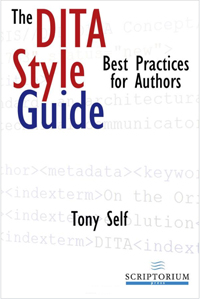
The DITA Style Guide: Best Practices for Authors, by Tony Self (Feb 24, 2011)
Links: Amazon.com

“As more companies implement DITA to streamline the development of technical content, the demand for DITA-literate technical communicators is growing. The DITA Style Guide: Best Practices for Authors provides comprehensive, practical explanations of DITA elements and attributes. Real-world examples and clear recommendations show you how to create consistent, semantically correct DITA content.
The DITA Style Guide: Best Practices for Authors is designed to help DITA authors implement DITA consistently by providing an authoritative reference (in the same way that The Chicago Manual of Style provides a reference for matters of language, writing and presentational style).
The DITA Style Guide is not an exhaustive set of rules or guidelines; it addresses the most common questions that DITA users ask, based on analysis of the Yahoo! DITA Users Group mailing list. The DITA Style Guide is not authoring-tool specific, so by necessity it uses neutral code examples, rather than examples of what might appear in a WYSIOO editor, or other tool-specific interactions. There are many practical examples, most built around a fictitious car manual.”
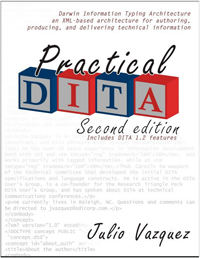
Practical DITA, by Julio Vazquez (Oct 6, 2009)
Links: Amazon.com

“This book presents a practical approach to creating information using the Darwinian Information Typing Architecture (DITA). It covers everything from planning the project to writing the topics that comprise an information set.
The second edition contains information about the DITA 1.2 features.”
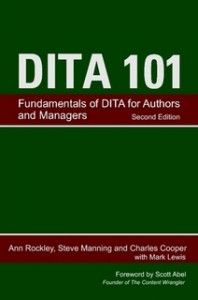
DITA 101, by Ann Rockley, Charles Cooper and Steve Manning (May 19, 2009)
Links: Amazon.com

“If you’re in the process of implementing DITA, expect to do so in the future, or just want to learn more about it without having to wade through technical specifications, this is the book for you.
This book covers everything you need to know about DITA.”
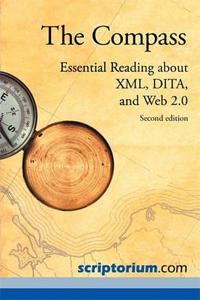
The Compass: Essential Reading about XML, DITA, and Web 2.0 (Second Edition), by Sarah S. O’Keefe and Scriptorium Publishing (Apr 20, 2010)
Link: Amazon.com

“Your guide to modern technical communication These white papers, also available at scriptorium.com, introduce you to critical tools and technologies, including structured authoring, Extensible Markup Language (XML), the Darwin Information Typing Architecture (DITA) and the DITA Open Toolkit, and user-generated content (blogs, wikis, and forums). The Compass provides essential information about the direction of technical publishing today. NOTE: The Compass is a compilation of white papers that are also available free at scriptorium.com. The book does not contain different or updated content.”
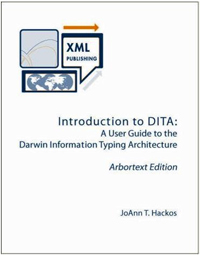
Introduction to DITA: A User Guide to the Darwin Information Typing Architecture, Arbortext Edition, by JoAnn T. Hackos (2007)
Link: Amazon.com

“As DITA becomes further entrenched as an ever more popular XML solution to topic-based authoring, a number of XML editors are available to assist content creators. This user guide is designed to provide its readers with a task-oriented approach to learning the Darwin Information Typing Architecture (DITA). In this edition, we introduce you to PTC’s Arbortext Editor. Procedures and examples in this book use Arbortext Editor. You will find conceptual overviews, background information, tutorials, and the sample XML markup you need to get started using DITA. You learn to use DITA at the same time you learn to apply the Arbortext Editor to authoring, conditional processing, and publishing. Here are some of the questions we help you answer: How do I create DITA topics? How do I assemble DITA topics into DITA maps for output? How do I do conditional processing with DITA? How do I create my own specializations? How do I use the DITA Open Toolkit?”
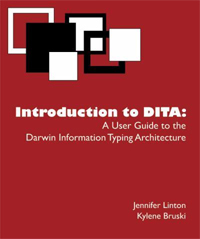
Introduction to DITA – A User Guide to the Darwin Information Typing Architecture, by Jennifer Linton and Kylene Bruski (2006)
Link: Amazon.com

“A user guide for the popular OASIS DITA standard. If you have been using DITA, or are just joining the DITA community, this book provides you with the information you need to accomplish your goals. The user guide not only presents the basic methodology of DITA and its benefits for creating your information set, but explains step-by-step how to author DITA XML topics, create maps for your deliverables, and work through the production processing tasks. The book includes a thorough explanation of the DITA model and the major elements used to create your topics using the task, concept, and reference information types. Procedures and examples in this book use XML code. The DITA User Guide uses a task-based approach (the user guide is written with DITA) to help you create topic-based output. Here are some of the questions we help you answer: How do I create DITA topics? How do I assemble DITA topics into DITA maps for output? How do I do conditional processing with DITA? How do I create my own specializations? How do I use the DITA Open Toolkit?”
Which sources would you recommend for a crash course on DITA–so that I could be immediately productive in a shop that uses DITA?
Sorry, I missed this comment when it was first posted.
The answer to your question depends on where you and your group of technical writers are. If you are wholly new to DITA I would suggest either the “Introduction to DITA” book by JoAnn Hackos and the from practice I know that “The DITA Style Guide”, by Tony Self makes for a good desk-side reference. I also think “Practical DITA”, by Julio Vazquez is very good, though I am hoping he will update that book soon.
If you and your writers already have a lot of experience with DITA then “DITA Best Practices” is what you need. If you are an Information Architect, pick up “DITA for Practitioners Volume 1”, by Eliot Kimber.
I like Julio’s book for beginners. I find Tony Self’s book to be a great reference but difficult to simply read.
Great information. Lucky me I found your site by accident (stumbleupon).
I have saved as a favorite for later!
I never, ever would have thought I would be required to be familiar with this, but thank goodness for the internet, right?
Here you can find a german book:
http://www.data2type.de/xml-xslt-xslfo/dita/
This resource section is great and useful. However, I was wondering if there are any books, papers or case study about the usability or translatability of DITA content. I am currently preparing my thesis on DITA and I would like to discuss these 2 aspects but I can mainly find information about ROI and translation cost reduction. Thanks for any suggestion!
Hello there Monica:
From an academic perspective I suggest you get in touch with Carlos Evia at Virginia Tech. I know he has done some academic studies on the subject of DITA and usability (I *think* both from a writing and user perspective). He is very approachable and I am certain that if you reach out to him at carlos.evia AT vt DOT edu you will get a response.
Another person you might want to reach out to Sissi Closs. She is a German academic who I believe has also done some research in this area. Her email is: closs AT ctopic DOT de.
You might also want to reach out to the people at CIDM (https://www.infomanagementcenter.com/) whose Best Practice magazine has covered many aspects of DITA over the years. The magazine is only for members but if you ask for articles on specific topics they may be able to help.
I remember running across a thesis about DITA published last year from Paris Diderot University in France. I tracked it down; you can find it here: https://f.hypotheses.org/wp-content/blogs.dir/1236/files/2015/11/2015-LEGUILLER-SAMIOS-VU-DINH-BA-ZAIRE-DITA_corrig%C3%A9.pdf.
As for the localization angle, if you can expand upon what you are looking for, I may be able to point you in the right direction. My email is keith AT ditawriter DOT com. Cheers!